How much SPF is enough?
Most of us use about half the sunscreen it takes to get the number on the pack. How much a face needs, how many passes of a stick that is, and when to go again.
The number on a sunscreen is measured in a laboratory, with a generous two milligrams of product on every square centimetre of skin. Real people, in real bathrooms, tend to use a quarter to a half of that. So the protection on the pack and the protection on your face can be very different things.
The fix isn’t a higher number. It’s more product, applied properly, and applied again.
For a face
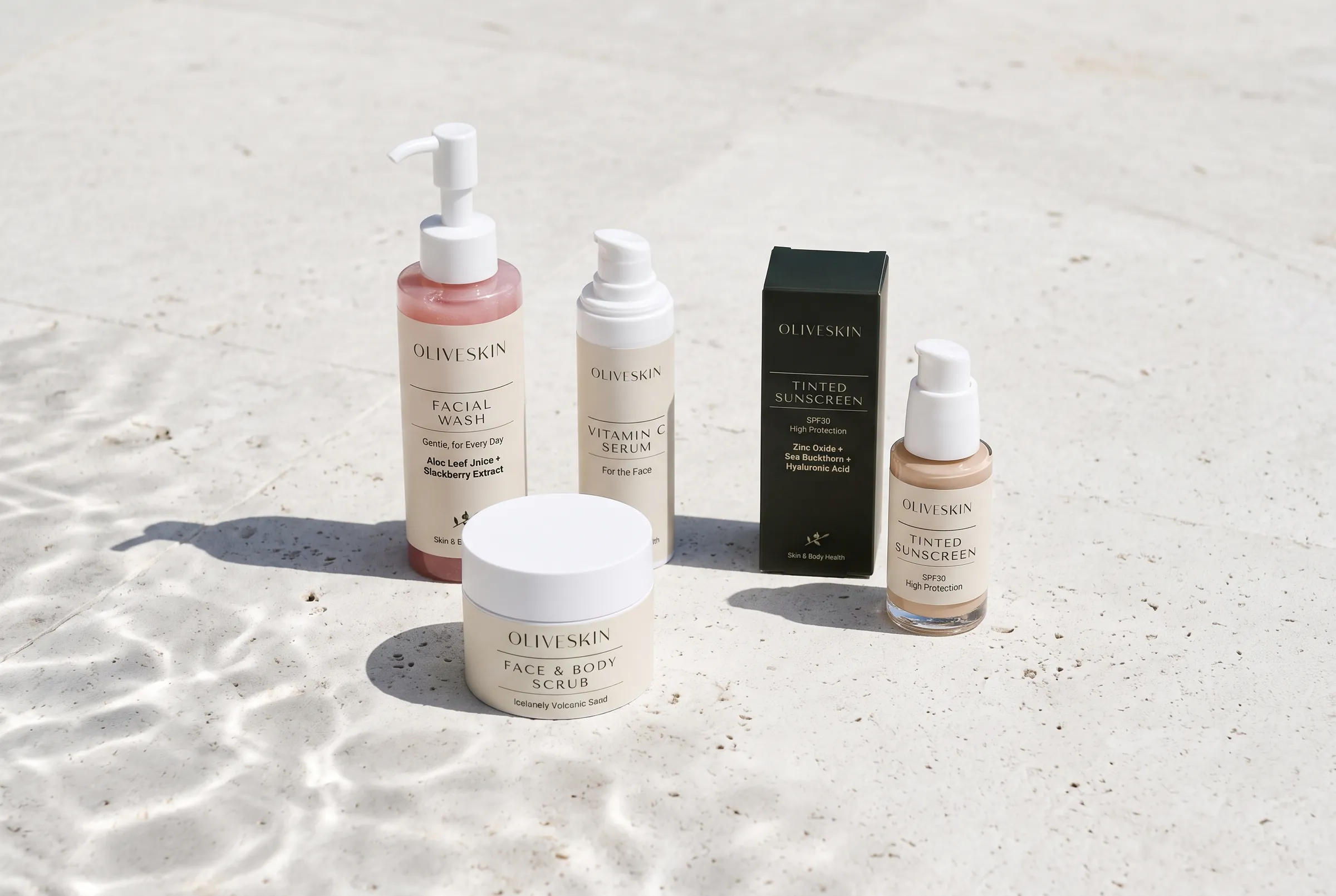
For face and neck, a good guide is about half a teaspoon of a fluid such as the Tinted Sunscreen: roughly two finger lengths, if you squeeze it along your fingers. It will feel like more than you’re used to. That’s the point. Spread it evenly, and don’t forget the ears, the hairline and the back of the neck.
If you wear glasses, do the bridge of your nose before you put them on. It is the most forgotten square centimetre in Britain.
For a stick
Sticks are brilliant for reapplying and easy to under-apply. One quick swipe across a cheek leaves a film too thin to do much. Go over each area three or four times, back and forth, then blend with your fingertips: forehead, each cheek, nose, chin, ears. It takes about thirty seconds.
Morning, last step
After washing and the Vitamin C Serum, a generous layer over face and neck, then give it a minute before make-up.
Tinted SunscreenEvery two hours outside
Several swipes per area, then blend. It goes over make-up, over the morning’s sunscreen, at lunch, on the school run, halfway up a hill.
Sun StickAfter water and towels
Straight after swimming, sweating or towelling, whatever the clock says.
Sun Stick
The best SPF is the one you actually reapply.
Is SPF30 enough?
For an everyday day in the UK, a well-applied SPF30 is good protection. SPF50 helps on long days outdoors, at altitude, near water or snow, and for skin that burns easily. Either way the number only holds if the amount does: a generous SPF30 beats a stingy SPF50.
And grey days count. UV gets through cloud, so if it’s light enough to see, it’s worth the thirty seconds.
The rest of you
Arms, shoulders, the backs of the hands and the tops of the feet catch the most sun and get the least attention. For a whole adult body on a beach day, the usual guide is six to eight teaspoons of lotion. The Sun Stick is made for the small, exposed parts in between: ears, nose, the parting in your hair, the backs of your hands.
Tint and make-up
A tinted product counts as sun protection only if you put on enough of it. The Colour Correcting Stick has SPF30 and is lovely for a quick blur; on a long day outdoors, treat it as the top layer, with your sunscreen underneath.
What SPF doesn’t do
Sunscreen reduces the sun’s damage; it doesn’t make time in the sun safe, and it isn’t a licence to stay out longer. Shade, a hat and the hours around midday still matter. Every skin colour needs protecting, including skin that rarely burns.
Mineral filters, in plain words: zinc oxide and titanium dioxide sit on the skin and absorb and scatter UV. The zinc oxide entry has the rest.
In plain wordsZinc oxide: The mineral filter in both sticks, and in the Tinted Sunscreen.
From this story
The three in this story
A sample with every order, free UK delivery over £45, and sixty days to change your mind, even opened.
Tinted Sunscreen
SPF30 High Protection · 30 ml
SPF30, no white cast
4.6(863)We write once, the day it’s back.
Join the waiting list