How we built the cabinet
Limestone, linen, the shadow of a branch and the light from the front left: how the cupboard on our home page became nineteen stills, and then a real wall in the Studio.
The first OLIVESKIN cabinet hung above a basin in a rented flat in Hackney: painted a green that was nearly black, never quite level, and full of bottles that promised everything. When we came to make the picture that opens our shop, we wanted that cupboard again, only honest. This is how it was built.
Sized for the bottles
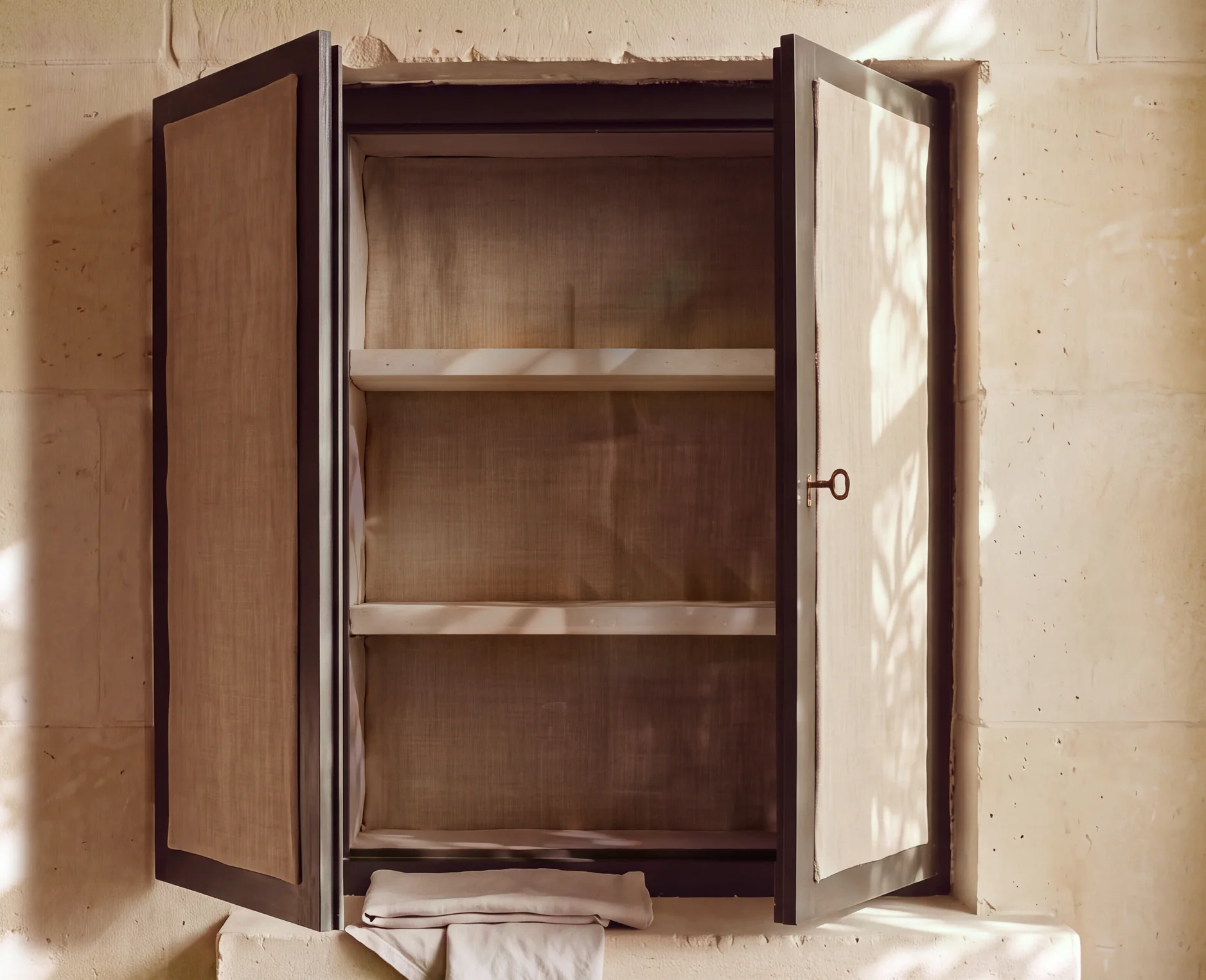
We started with a ruler, not a mood board. Every pack in the range was measured, and the cabinet was drawn around them: three spaces, one for each part of the range, divided by stone shelves about two centimetres thick. Make a cabinet too big and nine bottles look like a doll’s house. At about 65 by 45 centimetres, each one reads as itself from across the room.
It is set into the wall rather than hung on it, in a chiselled reveal, so it feels built with the house. The doors are wood, painted by hand in Black Olive, the deep olive-black of our labels, with the brush marks left in. There is a small brass key in the right-hand door. It does turn.
Limestone and linen
The wall is warm honed limestone in large blocks, and the shelves are a paler stone of the same kind. Behind the bottles, and on the inside of each door, is washed tan linen. We tried stone and paint first. A pale back swallowed the white jars and tubes; an olive-black one swallowed the dark bottles. Tan linen sits in between, so the white packs read lighter than it, the amber and green glass darker, and every pump shows.
The light from the front left
The light is late morning, about 35 degrees above the horizon, coming in from the front left through an olive tree you never see. That tree is why the doors carry soft oval flecks of sun and a few narrow leaf shadows. Every shadow in every picture falls back and to the right. When the doors open, the right door’s linen turns towards the sun and glows; the left one turns away into shade.
The bottom shelf sits in the tree’s shade, with a fleck or two. It suits a shelf that is waiting.
Nineteen stills
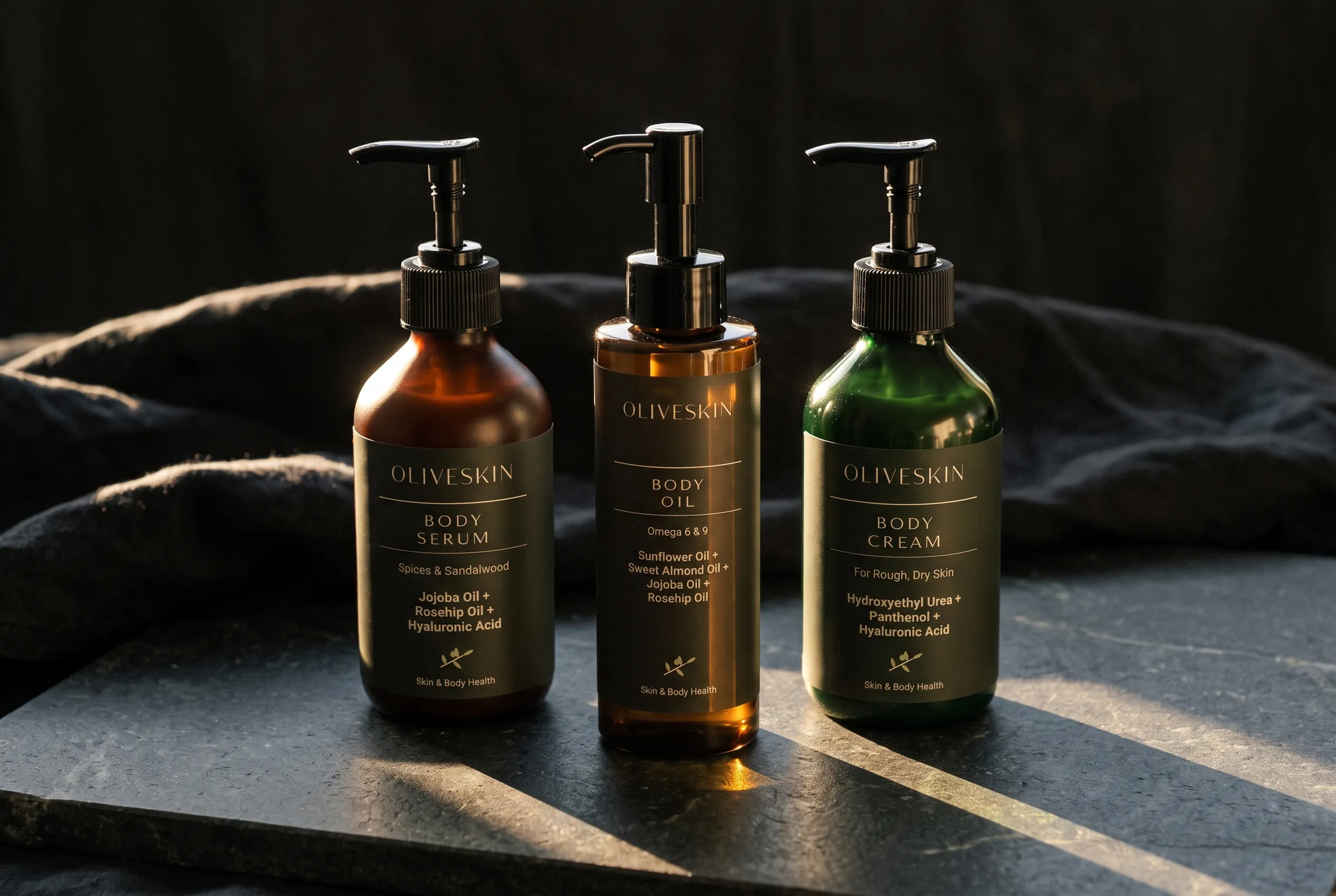
The cabinet on the home page is a stop motion of nineteen stills, about nine seconds from closed to full. Four hold it closed while the leaf shadows drift. Four take the doors from shut to open. One shows it open and empty. Then nine arrivals, one at a time: the three body bottles on the top shelf, the face and sun packs on the middle one, the wash on the bottom, and last of all a folded card that reads To follow. The nineteenth is the full cabinet, held for a breath before it starts again.
Each still is the one before it plus a single change. Nothing else moves, so nothing shimmers as the doors swing and the bottles arrive. The camera stays put for all nineteen: one lens, level with the middle shelf, verticals straight.
Each still is the one before it, plus one change.
Then a real wall
In 2023 the cabinet was built for real, as the back wall of our studio in Shoreditch: the same limestone, the same linen, and a door that sticks in August. The bottles on its shelves are the ones you can buy, and the long counter in front of it is where we offer a free 20-minute skin consultation.
Come and open it. The Studio is at 11 Linen Yard, open Tuesday to Saturday, 10 to 6, and Sunday, 12 to 5. Or open the one on our home page, which never closes.
The shopOpen the cabinet